
Category: Homepage content

  • Why Credible Is Not The Same As Memorable

    Why Credible Is Not The Same As Memorable

    Brand Memorability Financial Services

    THE FOUR DIMENSIONS THAT DETERMINE WHETHER A FINANCIAL SERVICES BRAND GETS REMEMBERED AND WHY MOST B2B MARKETING MISSES THEM.

    In brand memorability financial services research, one finding stands out: most firms are credible. Very few are memorable.

    Open a few different professional services or wealth management websites and hide the logos. How many can you tell apart?

    The same navy blues, stock photography and language of ‘Trusted partner’, ‘Client-first’, ‘Long-term relationships’. These category conventions are built from a place of trying to please everyone from compliance to sales and marketing to management. But in doing so they dilute what sets them apart and they end up in a sea of sameness where they are credible but indistinguishable from each other and as a result unmemorable.

    This matters because in a market with long sales cycles where 95% of buyers are not in-market at any given time (Ehrenberg-Bass Institute), being credible doesn’t drive long term growth, brand memorability does.

    THE COMMERCIAL CASE FOR MEMORY

    This is the commercial case for brand memorability in financial services: it isn’t a nice-to-have, it’s what determines whether your firm makes the shortlist at all.

    When Forrester asked B2B buyers how they approach a new purchase, 92% said they started their search with at least one brand already in mind. The firms on that shortlist are not necessarily the most qualified. They are the ones that are remembered.

    McKinsey’s State of Marketing Europe 2026 found that branding is now the number one priority for European marketing leaders, above performance marketing, AI and martech. That shift reflects something the data has been pointing to for some time, that the long game in B2B marketing is not the number views or clicks. It’s building memory structures that put your firm on a consideration list before the buying process begins.

    Binet and Field’s analysis of the IPA Effectiveness Databank makes the mechanism clear. Emotional campaigns significantly outperform rational ones on long-term commercial growth. Not because emotion is inherently more powerful, but because it builds the memory structures that make a brand top of mind the moment a buyer starts looking for a new product or service to solve a business challenge.

    So how can professional services or wealth management brands build stronger memory structures with future buyers? The Un4gettable Framework has been designed specifically to answer this question.

    THE FRAMEWORK

    The Un4gettable Framework measures brand memorability across four dimensions. Each dimension is built from published research in cognitive science, advertising effectiveness and brand strategy. Together they diagnose why a brand is being remembered or overlooked and what can be done to make it unforgettable.

    DIMENSIONDIAGNOSTIC QUESTION
    BeliefWhat does brand stand for?
    MomentsWill the message resonate?
    DistinctivenessIs it instantly recognisable without the name or logo?
    ConsistencyDoes the brand feel familiar?

    BELIEF

    What does this brand stand for?

    Byron Sharp’s research in How Brands Grow shows that functional claims are easily copied and rarely build long-term memory and System1’s analysis of tens of thousands of ads confirms why. Emotional resonance, rooted in a genuine brand belief, is the single strongest predictor of long-term commercial performance.

    What endures is not what a brand does, but what it stands for, succinctly expressed in a way that is easy to understand and can’t be replicated by a competitor.

    This distinction matters in professional and financial services more than in almost any other sector, because the functional offer across firms is so similar. A wealth manager that leads with ‘personalised service and long-term relationships’ has said nothing a competitor cannot claim. 

    Vanguard’s belief of providing value to investors is underpinned by its ownership structure. Vanguard is owned by its own funds, which are owned by the people who invest in them. Fidelity, BlackRock and Schroders can’t say the same thing, because it isn’t true of them.

    So the test is simple. Does or could another firm say the same thing that your firm wants to be known for? If the answer is yes, then you don’t have an ownable belief. You have a category convention.

    MOMENTS

    Will the message resonate?

    Ehrenberg-Bass research on Category Entry Points identifies the specific triggers, situations, needs and emotions, that bring a brand to mind during the buying process. An ad can be emotionally compelling without being commercially effective if the moment it depicts has no connection to the buying decision.

    A wealth management brand that depicts the moment a client realises their money could be working harder is connecting to a category entry point. The emotion and the buying trigger align. The same warmth applied to a moment with no purchase relevance generates sentiment, not consideration. 

    Most B2B marketing fails to resonate because it does not deliver the right message to the right person at the right time. HubSpot is a great example of thinking about the buyer journey and the category entry points. Founders Brian Halligan and Dharmesh Shah put it plainly in their own account of the company’s origin, ‘buyers didn’t want to be interrupted by ads, they wanted helpful information’.

    DISTINCTIVENESS

    Is it instantly recognisable without the name or logo?

    The Ehrenberg-Bass Institute found fewer than 15% of brand assets are truly distinctive. Most brands compete with visual and verbal identities their audience cannot place. This is primarily down to B2B brands following tried and tested design and verbal cues that position the brand as safe and professional.

    Distinctiveness comes from owning assets, whether colours, language, tone or imagery, and using them consistently enough that they belong to the brand in the buyer’s mind. In professional services, where most firms share the same visual vocabulary, even modest differences create a real competitive advantage. The challenge is not only in finding those differences, but also committing to them long enough for them to stick.

    Frontiers in Neuroscience research on storytelling supports this saying that consistently recognisable brand signals activate multiple memory encoding pathways simultaneously, building stronger recall than rational claims made in isolation.

    Mailchimp’s yellow-and-black palette, and Freddie the chimp, are exactly the kind of distinctive assets Ehrenberg-Bass research is describing. Consistent and not conforming to category norms so that they become known and recognised for it.

    In 2020, Mailchimp tested how far that recognition went through its ‘Did You Mean Mailchimp?’ which leaned into the fact that people were mistyping searches for a folk singer, a wrestling event and startups, as ‘Mailchimp’. Not many B2B brands could run that same test and survive it.

    CONSISTENCY

    Does the brand feel familiar?

    System1 and the IPA’s Compound Creativity research shows brands that maintain their creative style across campaigns significantly outperform those that reinvent with every campaign. Ehrenberg-Bass makes the same point from memory science that distinctive assets only build mental availability through sustained use.

    Consistency therefore is not a constraint but instead a gate that helps increase memorability: a brand that looks different with every campaign is simply starting over. The strongest creative in the world will not build brand equity if the next campaign looks like it belongs to a different firm.

    IBM is a good example of a consistent identity system with Paul Rand’s eight-bar logo unchanged since 1972. The message and creative has evolved from Solutions for a Small Planet to Smarter Planet to Let’s Create, tracking the evolution of the business itself. But one idea has sat at the centre of all of it since Thomas Watson coined it in 1911, Think. It named IBM’s staff magazine in 1935, its laptops from the 1990s, and its flagship conference since 2018.

    So, what holds a hundred years of reinvention together isn’t a fixed message. It’s a fixed identity that lets the message change without the brand losing itself.

    WHAT THIS MEANS IN PRACTICE

    These four dimensions work together. A brand with a genuine belief but inconsistent execution loses the compounding effect that makes the belief stick. A brand that is distinctive but never reaches buyers at the right moment generates recognition without consideration. Memorability is not a single lever. It is a connected system.

    Most B2B brands are weak on at least two of these four dimensions. The firms that score well across all four are not always the biggest. They are the ones clients remember when it matters.

    The Un4gettable Framework is the diagnostic we use to assess how a brand performs across all four dimensions and how it compares to its competitors. The output identifies where a brand is building memory, where it is blending in, and where the most significant opportunities are.

    WHAT SCORING WELL ACROSS ALL FOUR DIMENSIONS LOOKS LIKE

    Vanguard, HubSpot and Mailchimp each show one dimension working hard. Hiscox, the business insurer, is a rare brand scoring high across all four dimensions.

    Since September 2023, Hiscox have run an ongoing platform called ‘The Most Disastrous Campaign Ever’, built around 21 deliberately chaotic outdoor sites (sparking wires, a misspelled Hiscox logo, a blank newspaper wrap), later extended into ads that mimic Specsavers, Weetabix and Cillit Bang to dramatise the real cost of copyright infringement.

    Belief. Insurance marketing almost universally reassures. Hiscox’s point of view goes the other way in that running a small business is genuinely risky, mistakes happen and pretending otherwise insults the audience’s intelligence. The chaos in the ads is that belief, made visible.

    Moments. Every execution dramatises a real risk a small business owner buys insurance to cover from a data breach to a client dispute to a copyright slip. Not an abstract brand value with no connection to the purchase.

    Distinctiveness. Red and black, built through visible chaos rather than polish. Recognisable as Hiscox from across the room, and nothing like the navy-blue reassurance the rest of the category defaults to.

    Consistency. The platform has run for more than two years, across multiple markets and executions, each one obviously another instalment of the same idea rather than a fresh start.

    The commercial result is a meaningful rise in unaided brand awareness and search volume, contributing to Hiscox’s highest-ever annual profit.

    FIND OUT WHERE YOUR BRAND STANDS

    Our Un4gettable Framework measures brand memorability in financial services across four dimensions, each grounded in research from Ehrenberg-Bass, Byron Sharp and System1. We use this framework to assess how memorable a brand is and what it can do to become un4gettable.

    Learn more

    RESEARCH REFERENCES

    Ehrenberg-Bass Institute (Prof. John Dawes). 95:5 Rule: 95% of B2B buyers are not in-market at any given time.

    Ehrenberg-Bass Institute (Jenni Romaniuk). Distinctive Asset research: fewer than 15% of brand assets are truly distinctive. Building Distinctive Brand Assets, Oxford University Press, 2018.

    Ehrenberg-Bass Institute. Category Entry Points: the buying triggers and situations that bring brands to mind during purchase decisions.

    Byron Sharp, How Brands Grow. Distinctiveness over differentiation. Physical and mental availability as the primary drivers of brand growth. Oxford University Press, 2010.

    Binet & Field, IPA Effectiveness Databank. The Long and Short of It: emotional campaigns outperform rational campaigns on long-term growth.

    System1 & IPA. Compound Creativity (Oct 2024): brands that maintain consistent creative style significantly outperform those that reinvent with every campaign.

    Forrester, 2024. 2024 B2B Buyers’ Journey Survey – 92% of B2B buyers start their evaluation with at least one vendor already in mind.

    McKinsey State of Marketing Europe 2026. Branding is the number one priority for European marketing leaders, above performance marketing, AI and martech.

  • Own a Word Branding: Vanguard’s One Powerful Word

    Own a Word Branding: Vanguard’s One Powerful Word

    Own a word branding

    Own a Word Branding: What Vanguard’s Rise Can Teach You

    Own a word branding is the discipline behind Vanguard’s rise from “Bogle’s Folly” to a firm managing trillions, built on a single word: Value.

    Vanguard built more than $8 trillion in assets on a single idea, with 1 powerful word.

    Here is what that means for every professional services and wealth management firm still searching for theirs. 

    In 1974, Jack Bogle was fired. 

    The mutual fund company he had built pushed him out in a boardroom dispute. He was given a consolation prize, permission to stay on and run the administrative business. He called it Vanguard, after the flagship of Admiral Nelson’s fleet at the Nile. And in 1976, from this modest starting point, he launched the first index fund available to ordinary investors. 

    The investment industry dismissed it. Actively managed funds were the product. Selecting stocks, beating the market, earning the fee, that was the game. Bogle’s fund, which simply tracked the S&P 500 and charged almost nothing to do so, was called Bogle’s Folly. 

    Today, Vanguard manages more than $8 trillion. 

    They did not win because they promised the highest returns. They did not win because they outspent competitors on advertising. They won because they built a business around one word, Value, and they never once deviated from it. 

    The brands that command attention do not compete on services, sectors or credentials. They own a position in their clients’ minds. 

    What owning one powerful word means 

    Owning a word is one of the oldest ideas in brand strategy. But in practice it is rarer than it sounds, especially in professional services and financial services, where most firms communicate in an almost identical way. 

    Trusted partner. Long-term relationships. Client-first. Decades of experience. 

    These words are shared across the sector and appear on websites and marketing communications for established brands, challenger brands, premium brands and mass-market brands. 

    Owning a word is different.

    It means that when buyers hear that word, one firm comes to mind. The brand has claimed a position in memory that competitors have not, and cannot easily take. That’s the essence of own a word branding: a single, ownable position that competitors can’t easily copy.

    Volvo owns Safe. Not because no other car is safe, but because for decades, every product decision, every communication, every brand action has been filtered through the same idea. The word is earned through consistency, not claimed through advertising. 

    Disney owns Magical. Not because other theme parks are grim (though arguably some are!). But, because every park, every film, every piece of content asks the same question, does this feel magical? 

    Vanguard owns Value. Not because other asset managers are expensive. Because Vanguard’s ownership structure where funds are owned by their investors, not by outside shareholders makes value for investors a business truth. 

    Why this matters commercially, not just strategically 

    The Ehrenberg-Bass Institute’s research on brand growth makes the case that buyers default to brands they already know when the moment to purchase arrives. Most of the time, most of your potential clients are not looking for what you offer. When they do start looking, the shortlist is not assembled by rational comparison of credentials. It is assembled from memory. 

    This is the 95:5 rule. Ninety-five per cent of your potential clients are not in the market at any given moment. The brands they consider when they do enter the market are the ones they remember from when they were not looking. 

    The content you publish today, the position you hold consistently, the word you own, all of it is doing commercial work months and years before a sale happens. 

    Forrester’s 2024 Buyers Journey Survey found that 92% of B2B buyers already have at least one brand in mind before formal evaluation begins. They are not starting from scratch. They are starting from memory. 

    The word you own today is quietly deciding which shortlists you appear on tomorrow. 

    Why professional services struggles with this 

    Most professional services firms were not built around a brand idea. They were built around expertise. The founding logic is straightforward: we are very good at this, and clients will pay us to do it. 

    That works until the market fills with very good firms all saying the same thing, credibility, expertise, partnership, client-centricity. All terms that have become so commonplace and dressed in similar imagery and colours they have become meaningless,  

    The result is a sea of sameness. As one CMO told us recently: 

    “Every firm’s website looks like it was done by the same marketing agency.”  

    If your competitors could copy and paste your homepage onto theirs, your positioning is not distinctive enough. And if nothing sets you apart, you won’t own a word. You’ll just be another firm clients can’t quite place when it matters most. 

    What it takes to own a word 

    • The word has be true. Vanguard’s ownership structure makes ‘value’ unchallengeable. Volvo’s engineering investment makes ‘safe’ credible. A word you claim without delivering against it is a positioning statement, not a brand truth. And buyers, even when they cannot articulate why, feel the difference. 
    • The word has to be held long enough to stick. Ehrenberg-Bass research shows that distinctive brand assets build mental availability only through sustained, consistent use. A new word every three years is not brand strategy. It is starting over. System1 and the IPA’s Creative Consistency Score shows that brands maintaining consistent creative style significantly outperform those that reinvent with every campaign. 
    • The word has to cost something to say. The test of a genuine brand position is whether it rules anything out. ‘Value’ cost Vanguard real margin for decades. ‘Safe’ cost Volvo the sporty segment. If your word pleases everyone, it belongs to no one. 

    The question worth sitting with 

    What word does your firm own? 

    Not what word appears in your brand guidelines. Not what you wish clients associated with you. What word comes to mind, unprompted and consistently when a client thinks of your firm? 

    If the answer takes longer than a few seconds, you’re not alone. Most professional services firms have three or four ideas competing for the same space. The problem is that clients don’t carry three or four ideas. They carry one. And if yours isn’t clear to you, it won’t be clear to them. 

    A single organising idea changes that. It’s the concept that holds your positioning, your culture, and your communication together, so every touchpoint reinforces the same thing. 

    If you’re not sure what yours is, own a word branding is exactly the conversation worth having – get in touch.

    Research references: Ehrenberg-Bass Institute (95:5 rule, distinctive assets); System1 / IPA Creative Consistency Score; Forrester Buyers Journey Survey 2024; Binet & Field IPA Effectiveness Databank. 

  • Thinking About a B2B Rebrand? Here’s What Makes It Work

    Thinking About a B2B Rebrand? Here’s What Makes It Work

    B2B Rebrand

    Considering a B2B rebrand?

    Get the timing and the reasoning wrong, and it becomes an expensive distraction rather than a strategic lever.

    In 8 minutes, you’ll learn:

    • When a rebrand is the wrong move and what to do instead.
    • The two questions that predict success: why you are rebranding and how well can you implement it?
    • Five principles that make rebrands stick.
    • Anonymised examples from wealth management and professional services.

    If you’re a CMO or senior B2B marketer in wealth management or professional services, a rebrand may be on your agenda. Perhaps the business has evolved its products or services, growth ambitions may demand a more focused and distinctive market positioning, or you are under more competitive pressure. 

    This is the stage where it is easy to move too fast. 

    In our experience, the difference between a successful and an expensive distraction comes down to two questions:

    1. What business problem is the rebrand solving?
      • Growth, relevance, trust, differentiation, or organisational alignment?
    2. How robustly can we implement it consistently across the organisation?
      • Not just in marketing, but across sales, advisers, leadership, and client touchpoints.

    If either answer is unclear, the rebrand risks becoming cosmetic and inconsistent, which will erode trust rather than strengthen it.

    The earliest stage of a rebrand is the most critical and the most often glossed over. It is where the biggest risks sit. Rebranding can be a powerful strategic lever, but it is not a cure-all. When undertaken for the wrong reasons, or without organisational commitment, it can create confusion, unsettle clients, and weaken credibility.

    This article is designed to help you pause, pressure-test your thinking, and make better decisions before momentum takes over. 

    If you are still questioning whether your organisation really needs to rebrand, focus on the sections on when rebranding is the wrong move and the warning signs to watch for. If you are already confident in the case for change, the examples and success principles later in the article will help you avoid common pitfalls and strengthen your approach.

    And if you want an honest, no-pressure view on whether rebranding is right for your organisation at all, please do get in touch for a straightforward strategic conversation. 


    When rebranding is the wrong move  

    In B2B marketing buying decisions are slow and complex, audiences are broad, and trust is built over time.  Therefore, rebranding must be carefully considered because the implications can be far reaching and long lasting.  

    A well-executed B2B rebrand can focus positioning, support growth, and improve marketing effectiveness. However, a poorly judged rebrand can create confusion across sales teams, partners, and customers.  

    Logo of Aberdeen before and after they completed a b2b rebrand

    Aberdeen illustrates the risks of prioritising novelty over clarity in a trust-led category. It attracted significant ridicule and confusion, and in 2025 the company moved back towards Aberdeen branding. 

    The difference between a successful or unsuccessful rebrand comes down to two questions. 

    1. Why is the organisation rebranding?

    A rebrand is not a good idea when the organisation cannot clearly articulate the business problem it is trying to solve. 

    If the motivation is vague such as a desire to look more modern, to keep up with competitors, or to satisfy internal preferences, the risk is that the rebrand becomes cosmetic. In B2B marketing visual change rarely delivers value. It can distract teams, unsettle long-standing clients, and consume budget without improving perception or performance. 

    Rebranding is also risky when the underlying strategy, proposition, or operating model has not yet stabilised. In these cases, the brand is asked to paper over uncertainty rather than express clarity. The result is often a brand that quickly feels outdated or disconnected from reality. 

    When there is no clear strategic rationale, rebranding can erode trust as clients and partners may question what has changed. 

    2. How robustly is the change implemented across the organisation?

    Even when the strategic case for rebranding is sound, poor implementation can undermine the outcome. 

    A rebrand that lives only in marketing assets, while sales teams, advisers, and partners continue to operate in the old world, creates fragmentation. Different parts of the organisation tell different stories, use different language, and project different levels of confidence. Over time, this inconsistency weakens credibility. 

    In complex B2B environments like wealth management, the brand is often experienced through people before platforms or campaigns. If employees do not understand what the brand stands for, how it supports the proposition, or how it should shape behaviour, the rebrand becomes superficial. 

    Incomplete implementation also leads to internal friction. Teams question decisions, revert to legacy materials, or dilute the brand through well-intentioned compromise. What was meant to create clarity instead introduces noise. 

    A robust rebrand requires governance, prioritisation, and sustained commitment. Without this, even a well-conceived strategy struggles to deliver lasting impact. 

    Why and when should B2B companies choose to rebrand?

    In B2B environments, rebranding is rarely driven by aesthetics. It is typically triggered by strategic pressure or organisational change that the existing brand can no longer carry. 

    Strategic repositioning and growth

    As B2B organisations expand into new markets, develop more complex offerings, or move up the value chain, their brand often lags behind the reality of the business. What once worked for a narrower proposition can start to undersell expertise or confuse buyers. 

    Research from the LinkedIn B2B Institute shows that long-term growth depends on building clear and consistent brand associations in buyers’ minds, particularly among future customers who are not yet in-market. Rebranding can help reset those associations when strategy evolves. 

    Mergers, acquisitions, and organisational complexity 

    M&A activity is a common trigger for rebranding. Multiple propositions, cultures, and operating models can create confusion both internally and externally. 

    In these situations, rebranding provides a mechanism for alignment. It helps unify disparate parts of the organisation around a shared narrative and makes it easier for customers to understand what the combined business now offers. 

    Loss of differentiation in mature markets 

    Many B2B categories suffer from convergence. Messaging becomes interchangeable, visual identities look similar and claims of expertise blur together. Research from the Ehrenberg-Bass Institute highlights the importance of distinctiveness and mental availability in driving brand choice, even in rational, high-consideration B2B categories. Rebranding can help rebuild that distinctiveness when it has eroded. 

    Trust, credibility and perception gaps 

    In long sales cycles, trust matters. Some organisations rebrand because their external perception no longer reflects how they operate today. This may follow changes in leadership, governance, sustainability practices, or operating standards. In these cases, rebranding acts as a signal of intent. It provides a platform to communicate change clearly and consistently over time. 

    Internal misalignment 

    A less visible but equally important driver is internal confusion. If employees struggle to articulate what the business stands for, or if brand, strategy, and culture are pulling in different directions, performance suffers. Rebranding can act as a catalyst for alignment, particularly when paired with clear positioning and behavioural guidance. 

    Across all these scenarios, rebranding is not about reinvention. It is about restoring clarity and relevance in a complex B2B environment. 

    What makes a B2B rebrand successful? 

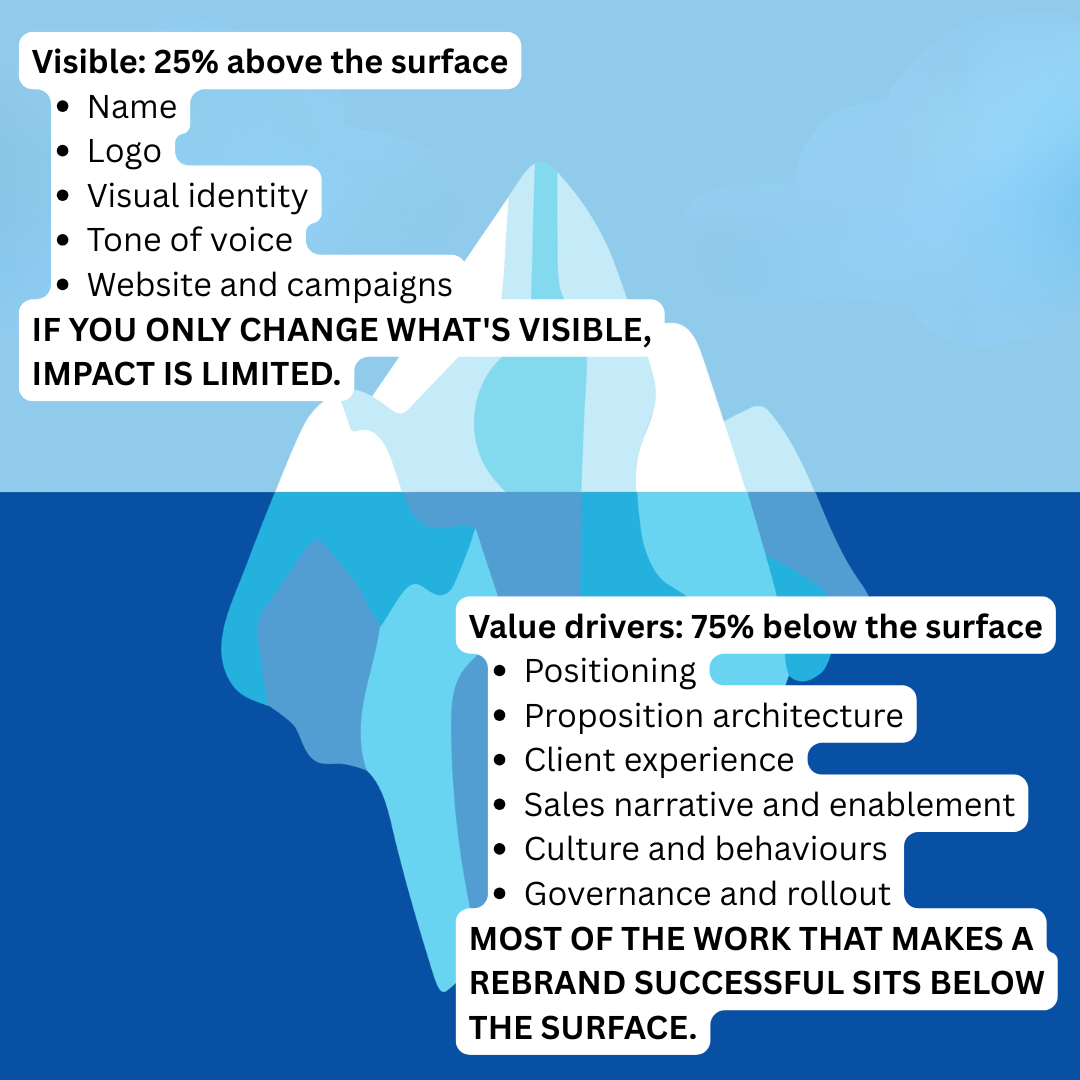
    Iceberg illustration showing rebrand value drivers

    1. Strategy leads, design follows 

    Strong B2B rebrands begin with a clear strategic diagnosis. Leadership teams define the commercial problem the rebrand must solve and the role the brand should play in growth. This aligns with guidance from the LinkedIn B2B Institute, which consistently emphasises that brand building is a long-term investment, not a short-term campaign. Visual change without strategic clarity rarely delivers impact. 

    2. Clear positioning across complex buying groups 

    B2B brands speak to multiple stakeholders with different priorities. Procurement, technical buyers, senior stakeholders, and end users all interpret the brand through their own lens. Successful rebrands establish a clear core positioning that can flex across these audiences without losing coherence. This clarity supports sales conversations, thought leadership, and account-based marketing alike. 

    3. Internal alignment before external activation 

    The brand is often delivered by people long before it is experienced through marketing. Sales teams, account managers, and subject matter experts play a critical role in shaping perception. Rebrands that invest in internal understanding and adoption perform better over time. Employees need to understand what has changed, why it matters, and how it should influence behaviour and decision-making. 

    4. Disciplined execution across priority touchpoints 

    B2B rebranding succeeds when treated as a structured change programme. Organisations prioritise high-impact touchpoints such as the website, sales materials, proposals, and thought leadership before attempting full rollout. This approach reduces risk and ensures consistency where it matters most in the buying journey. 

    5. Built for longevity, not launch day 

    The most effective B2B rebrands are designed to endure. They create systems and principles that support future growth, new offerings, and organisational change without requiring another reset. This long-term mindset reflects what research repeatedly shows. Brands grow by being remembered and recognised over time. 

    What we’ve learned from rebranding wealth management and professional services brands

    The examples below reflect patterns we see repeatedly across successful B2B rebranding programmes. 

    Wealth management example: appealing to existing and future clients 

    In one wealth management business, growth ambitions depended on attracting a new generation of clients while continuing to serve long-standing relationships built over decades. 

    Externally, the firm was trusted but often perceived as traditional and narrowly focused. Internally, teams knew the business had evolved, with broader capabilities, more sophisticated advice, and a more progressive outlook than the brand suggested. 

    Rather than starting with design, the rebrand began with conversations. Existing clients were asked why they chose the firm, what they valued most, and how they described it to others. The insight was clear. Clients trusted the firm not because of heritage alone, but because of the quality of relationships, the depth of thinking, and the clarity of advice. 

    The rebrand focused on amplifying those strengths. The result was a brand that felt reassuring to existing clients while signalling relevance and confidence to future ones. 

    Professional services example: standing out from a sea of sameness 

    For a professional services firm operating in the highly competitive infrastructure category, leadership recognised that the brand had become indistinguishable from peers. The market was crowded with similar promises, similar visual identities, and similar tone of voice. Despite strong performance and loyal clients, the brand was not helping the firm stand out and support business development through long term contract tenders. 

    Client research revealed that what truly differentiated the firm was not a range of products and services but how it worked. Clients valued its holistic approach and ability to simplify complex issues. 

    The rebrand focused the positioning on these qualities with visual and messaging designed to reinforce this brand narrative. The firm emerged with a brand that felt distinct, credible, and easier for teams to use in conversations with prospective clients. 

    Professional services example: competing for C-suite attention 

    A global management consulting firm had grown rapidly through mergers and acquisitions, expanding its capabilities and geographic reach. Despite this growth, the brand struggled to compete with established market leaders for C-suite attention. 

    Senior executives found it difficult to quickly understand what the firm stood for and why it was different. Yet client insight revealed a clear strength. The firm was trusted for delivering practical, implementable solutions that helped organisations transform operations and adapt to change, rather than offering purely conceptual advice. 

    The rebrand focused on sharpening this positioning. The brand narrative emphasised action, outcomes, and real-world impact, speaking directly to C-suite concerns around execution risk and long-term resilience. 

    With senior leadership involved from day one and a clear rationale shared across the organisation, the result was a confident, coherent brand. One that supported competitive pitching, unified teams across markets, and strengthened credibility at the highest level of decision-making. 

    What made these B2B rebrands successful

    While the contexts differed, the success factors were consistent. 

    Client insight was treated as essential, not optional. Understanding why clients chose the firm and what they believed set it apart grounded the rebrand. What clients say in a conversation often reveals the emotional drivers behind rational decisions such as trust, confidence, responsiveness, and the feeling of being understood. 

    AI can help synthesise themes and segment audiences at speed, and it can be a useful tool for organising insight once it has been gathered. However, it does not replace the value of hearing directly from clients and colleagues. Face-to-face discussions uncover nuance that rarely makes its way into surveys or secondary research, such as what makes people hesitate, what language they naturally use, and what they fear losing if a brand changes. 

    Internal insight mattered. The strongest rebrands involved conversations with internal teams across marketing, sales, advisers and leadership teams. These discussions surfaced where the organisation felt most confident, where it felt exposed, and where teams were already improvising because the current brand did not reflect how they worked. That input helped create a brand that people could deliver, not just describe. 

    Senior leadership were active participants from day one. Their involvement ensured strategic clarity, faster decision-making, and organisational buy-in. In practice, this meant in-person workshops and working sessions with the senior leadership team to sense-check what had been learned, align on the rationale for the brand strategy, and make the trade-offs that every strong positioning demands. These sessions also created space to address concerns early, rather than letting doubt grow quietly and emerge later as resistance. 

    The process was transparent and collaborative. Data, insight, and rationale were shared across the organisation, so colleagues understood both the direction and the reasoning behind it. This is where human interaction is critical again. A deck shared by email rarely builds belief. Workshops, town halls, and small-group sessions give people the chance to ask questions, challenge assumptions, and contribute. When colleagues feel listened to and can see their input reflected, adoption becomes far more natural. It also builds consistency, because people understand the why and not just the what. 

    In each case, rebranding was not about reinvention. It was about making the organisation’s value clearer, more distinctive, and more relevant to the world it was operating in. The human work of listening, aligning, and bringing people with you is what turns a rebrand from a new identity into a change that sticks. 

    B2B rebranding: Find Your Angle

    People working together on a b2b rebrand

    AI can accelerate research and help structure thinking quickly, but nothing replaces in-person conversations and workshops with clients, colleagues and leadership teams. These discussions test assumptions, surface nuance, address concerns early, and create shared ownership. That ownership builds the confidence and alignment needed to roll out the brand strategy consistently.

    If you’re considering rebranding or want an honest conversation about whether you need one at all, please reach out.

  • Wealth Management Brand Positioning: Stand Out in 2026

    Wealth Management Brand Positioning: Stand Out in 2026

    Wealth Management Brand Positioning

    Wealth Management Brand Positioning and the Sea of Sameness

    Wealth management brand positioning is the difference between winning attention and disappearing into a crowded market. At Find Your Angle, we help financial services brands break free from the sea of sameness by developing a distinctive, memorable positioning that drives attention and conversions.

    After analysing over 250 wealth management and asset management brands, we know that clear, compelling messaging wins – while generic messaging underperforms. Discover your angle and make your brand the one clients remember first.

    Shared visual themes are common in commoditised industries, but with clear positioning your brand remains differentiated and easy to recall. This is especially important under the 95:5 rule, where only a small fraction of your audience is actively in market.

    Ready to sharpen your 2026 brand positioning?

    Our full analysis for 2025 is now available here, where we’ve explored areas of overlap, identified opportunities, and observed how AI and innovation themes are emerging in competitor positioning and comms.

    Sharpen Your Wealth Management Brand Positioning for 2026

    To find out how you compare to your competitors and how you can win in 2026, please get in touch.

    Source: How B2B Brands Grow The Ehrenberg-Bass Institute for Marketing Science